


Victron Energy Phoenix Battery Charger, 120-240V AC, 2+1 Outputs




-
Perfect Fit, Guaranteed
Get the right part every time
-
Expert Support
Our in-house specialists know our products inside and out
-
Enhanced Value & Service
We go beyond the sale with professional and balanced services
-
Wordwide Delivery
Enjoy hassle-free worldwide delivery
Victron Energy Phoenix Battery Charger, 120-240V AC, 2+1 Outputs
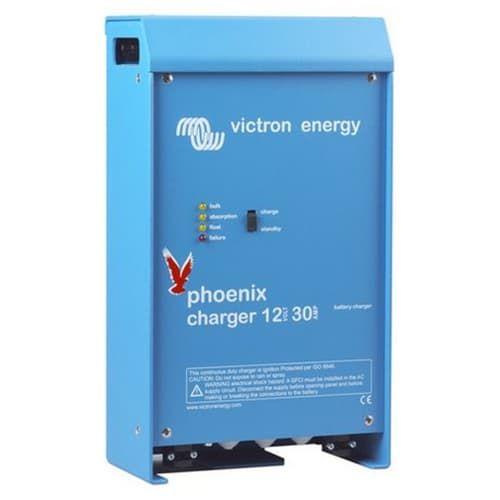
Victron Energy Phoenix Battery Charger, 120-240V AC, 2+1 Outputs
Overview
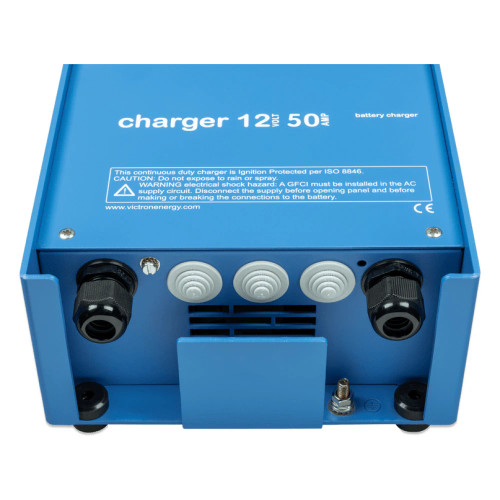
The Victron Energy Phoenix Charger is a mounted adaptive battery charger for 12 V or 24 V battery systems, with two full-rated house-battery outputs plus a 4 A starter-battery output. It is built for boats that need a fixed charger connected to shore power or a generator, while still keeping separate battery banks properly managed.
The charger accepts 90-265 V AC at 45-65 Hz and can also accept 90-400 V DC input. Its 4-stage adaptive charge profile covers bulk, absorption, float, and storage stages, with charge behavior that responds to how the batteries are being used.
The aluminium enclosure is rated IP21, so it belongs in a protected electrical space such as a dry locker, electrical cabinet, or engine-room area with suitable ventilation. Across this range, battery connection is made through M6 studs and the AC connection uses a screw-clamp terminal for up to 4 mm² cable.
Key features
- Available for 12 V systems at 30 A or 50 A, and for 24 V systems at 16 A or 25 A.
- Two full-rated charging outputs support house-battery charging, while the dedicated 4 A output keeps a starter battery maintained.
- Adaptive 4-stage charging uses bulk, absorption, float, and storage stages to reduce unnecessary time at higher voltage when batteries are only lightly discharged.
- Universal 90-265 V AC input works with common marina shore-power and generator supplies, with 90-400 V DC input capability for suitable system designs.
- Battery voltage sense helps compensate for voltage drop in longer cable runs between the charger and battery bank.
- Battery temperature sensor support allows charge voltage to adjust when battery temperature changes, which matters in engine rooms and enclosed lockers.
- Protection functions cover output short circuit, battery reverse polarity detection, battery voltage too high, and temperature too high.
- IP21 aluminium enclosure, forced cooling, M6 battery studs, and screw-clamp AC connection support fixed installation in a protected onboard electrical space.
Variants
The Phoenix Charger range is offered in multiple configurations for different onboard battery systems and charging requirements.
The variants differ by nominal battery voltage and house-battery charge current. The same 90-265 V AC input range, 90-400 V DC input capability, two full-rated outputs plus 4 A starter output, IP21 aluminium enclosure, M6 battery studs, and 350 x 200 x 108 mm case size apply across these four configurations.
- PCH012030001: 12 V battery voltage, 30 A charge current. This configuration matches 12 V house banks in the 100 to 400 Ah range.
- PCH012050001: 12 V battery voltage, 50 A charge current. This configuration suits larger 12 V house banks in the 200 to 800 Ah range where higher charging current is needed.
- PCH024016001: 24 V battery voltage, 16 A charge current. This configuration matches 24 V house banks in the 100 to 200 Ah range.
- PCH024025001: 24 V battery voltage, 25 A charge current. This configuration supports 24 V house banks in the 100 to 400 Ah range.
Installation and setup
This is a fixed charger, so mounting location matters. Because the enclosure is IP21 and rated for up to 95 percent non-condensing humidity, it should not be placed where it can be sprayed, washed down, or exposed to standing water. A dry electrical compartment with airflow is the right environment, especially because the charger uses forced cooling.
The operating temperature range is -20 to 60°C, with full charge current specified up to 40°C ambient. On boats where chargers are installed near engines, in lazarettes, or behind panels, cable routing and ventilation should be planned before mounting.
Electrical and system integration
The Phoenix Charger can be used as a battery charger or as a power supply. Voltage sense terminals help the charger read battery voltage more accurately at the bank, which is useful when the charger is mounted away from the batteries and cable resistance would otherwise affect charging voltage.
An RS-485 data port allows computer configuration through VEConfigure when used with the required interface. This is useful for installers who need to adjust charging parameters to match the battery type and the way the vessel is used.
Use cases on board
This charger range fits vessels with a separated house bank and starter battery, including cruising sailboats, powerboats, fishing boats, and workboats that spend time connected to shore power between trips. The storage mode is useful for boats that sit at the dock for long periods, since it lowers float voltage after the batteries have not been discharged for 24 hours and periodically raises voltage again to help reduce electrolyte stratification and sulphation.
We ship all in-store (FL) stock orders the same day if placed before 3 PM EST, Monday through Friday. Orders placed after this time will ship the next business day. Orders fulfilled from other warehouses or manufacturers may not ship the same day. If an item is out of stock, we will notify you promptly.
Related Products
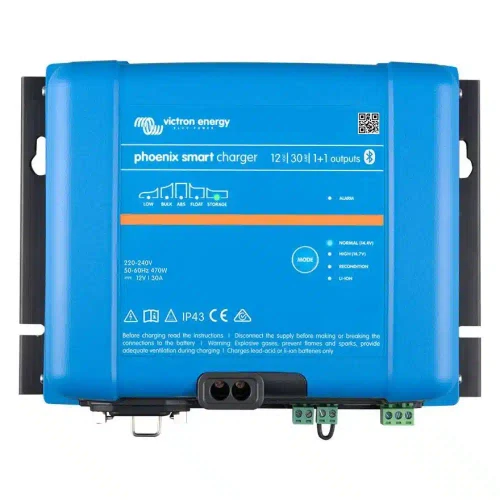

Victron Energy Phoenix Smart IP43 Battery Charger, 1+1 Output, 120-240V AC, Bluetooth

Victron Energy Phoenix Smart IP43 Battery Charger, 3 Outputs, 120-240V, Bluetooth


Victron Energy Centaur Battery Charger, 120-240V AC Input, 3 Isolated Outputs


Victron Energy Skylla-TG GMDSS Battery Charger, 24V, 120-240V, VE.Net Panel Compatible
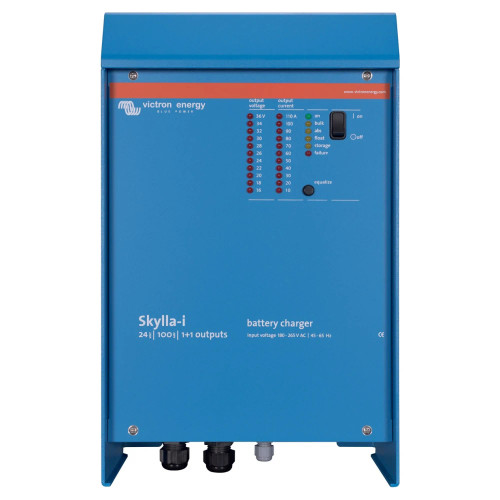

Victron Energy Skylla-i 24V Battery Charger, 230VAC, 1+1 Output, NMEA 2000