


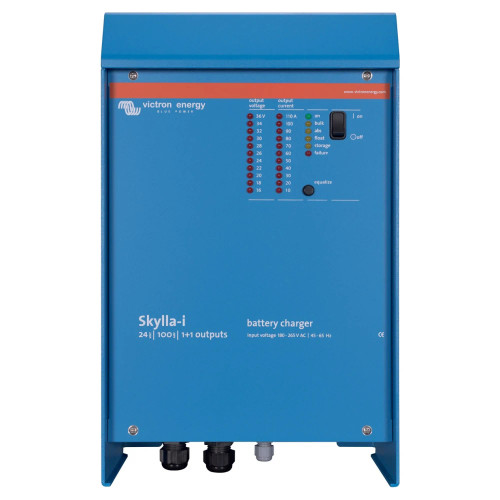
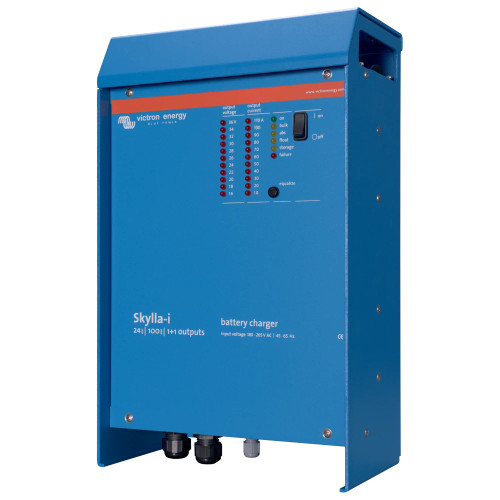
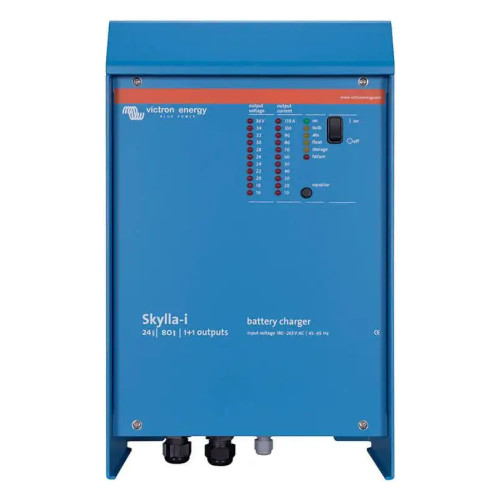
Victron Energy Skylla-i 24V Battery Charger, 230VAC, 1+1 Output, NMEA 2000




-
Perfect Fit, Guaranteed
Get the right part every time
-
Expert Support
Our in-house specialists know our products inside and out
-
Enhanced Value & Service
We go beyond the sale with professional and balanced services
-
Wordwide Delivery
Enjoy hassle-free worldwide delivery
Victron Energy Skylla-i 24V Battery Charger, 230VAC, 1+1 Output, NMEA 2000

Victron Energy Skylla-i 24V Battery Charger, 230VAC, 1+1 Output, NMEA 2000
Overview
The Victron Energy Skylla-i 24V Battery Charger (1+1), 230V is a high-output 24V battery charger for boats using a large service bank and a separate starter battery. The 1+1 output layout gives the main battery bank the full charger output while a second isolated output, limited to approximately 4A, keeps a starter battery topped up.
This charger runs from 230V AC with a 185-265V AC input range and can also accept 180-350V DC supply. It uses a 7-stage adaptive charge algorithm for lead-acid batteries, has a LiFePO4-ready charging mode with on-off or CAN bus control, and includes VE.Can communication using the NMEA 2000 protocol.
For marine installations, it is a strong fit for 24V house banks on cruising boats, workboats, and larger electrical systems where shore power or generator charging needs to be managed carefully. PowerControl allows the input current to be limited when the boat is connected to restricted dock power or a smaller genset.
Key features
- 1+1 charging layout with one full-output bank connection and one isolated starter-battery output limited to approximately 4A.
- Available in 80A and 100A charge current configurations for different 24V battery bank sizes.
- 230V AC input with a 185-265V AC input range, 45-65Hz frequency support, and 180-350V DC supply capability.
- 7-stage adaptive charging for lead-acid batteries, with variable absorption time, BatterySafe mode, float, and storage behavior.
- LiFePO4-ready operation with remote on-off control or current and voltage control through the isolated CAN bus port.
- VE.Can communication through two RJ45 connectors using the NMEA 2000 protocol.
- Synchronised parallel operation through VE.Can for systems that require multiple matching chargers.
- Aluminium epoxy powder coated enclosure with a drip shield, stainless steel fixings, and acrylic-coated circuit boards for heat, humidity, and salt-air exposure.
- Battery voltage sense and a battery temperature sensor help the charger compensate for cable loss and battery temperature changes.
- IP21 protection category, M8 battery connections, and a 405 x 250 x 150 mm enclosure for planning the mounting location.
Variants
The Skylla-i 24V Battery Charger (1+1), 230V is offered in two charge current configurations. Both variants use the same 1+1 output concept, 230V input platform, VE.Can communication, IP21 enclosure rating, and 24V charging architecture.
The main difference is the maximum charge current to the primary battery bank and the battery capacity range associated with that output level. The starter-battery output remains approximately 4A on both versions.
- SKI024080000: Charge current 80A. This version matches 24V battery banks in the 400-800Ah range and keeps the secondary 4A output available for starter-battery maintenance.
- SKI024100000: Charge current 100A. This version matches larger 24V battery banks in the 500-1000Ah range while keeping the same 1+1 bank arrangement for service and starter batteries.
Installation and setup
Mount the charger in a dry, protected electrical space with enough airflow for forced cooling. The IP21 rating is appropriate for a protected locker or technical compartment, not for exposed deck mounting or direct washdown areas.
The battery side uses M8 bolts, and the 230V AC connection uses a screw-clamp terminal rated for 10 mm² cable. Cable sizing, overcurrent protection, AC isolation, and battery fusing should be matched to the selected 80A or 100A model and the vessel electrical standards used on board.
Electrical and system integration
VE.Can integration lets the charger communicate on a CAN bus network using the NMEA 2000 protocol, with two RJ45 ports for network connection. In more involved Victron systems, this helps with monitoring, control, and coordinated charging behavior.
The remote on-off port can be tied into a Li-ion BMS where the battery system needs authority over charger operation. The charger can also be used as a stabilized 24V power supply when a battery bank or large buffer capacity is not present.
Use on board
This charger is well matched to boats with a 24V service bank that spends time on shore power, runs a generator, or needs fast recovery after hotel loads, navigation electronics, refrigeration, pumps, or inverter use. The separate low-current starter output is useful where the start battery should stay maintained without giving it the same charging load as the house bank.
For long dockside periods, storage mode lowers the float level after the battery has not been discharged for 24 hours, then periodically refreshes the battery. That behavior helps reduce unnecessary gassing and plate corrosion in lead-acid banks during standby use.
We ship all in-store (FL) stock orders the same day if placed before 3 PM EST, Monday through Friday. Orders placed after this time will ship the next business day. Orders fulfilled from other warehouses or manufacturers may not ship the same day. If an item is out of stock, we will notify you promptly.
Related Products


Victron Energy Skylla-i 24V Battery Charger, 230V, 3 Outputs, NMEA 2000


Victron Energy Skylla-TG 24/100 (1+1) Battery Charger


Victron Energy Skylla-TG GMDSS Battery Charger, 24V, 120-240V, VE.Net Panel Compatible

Victron Energy Skylla-i Control GX Remote Panel, For Skylla-i Chargers, Right Angle RJ45


Victron Energy Phoenix Battery Charger, 120-240V AC, 2+1 Outputs