


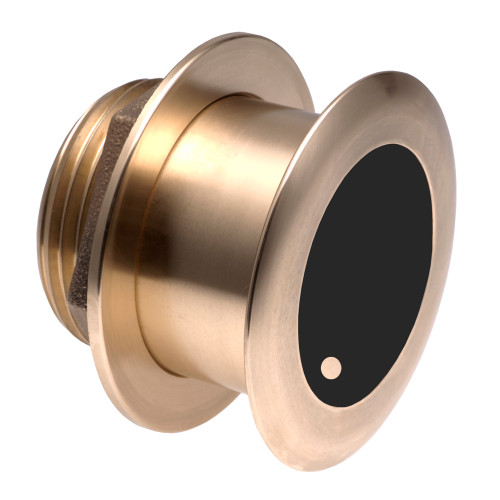
Garmin B175 Bronze Thru-Hull CHIRP Transducer, 1kW, Depth/Temp, 8-Pin

-
Perfect Fit, Guaranteed
Get the right part every time
-
Expert Support
Our in-house specialists know our products inside and out
-
Enhanced Value & Service
We go beyond the sale with professional and balanced services
-
Wordwide Delivery
Enjoy hassle-free worldwide delivery
Garmin B175 Bronze Thru-Hull CHIRP Transducer, 1kW, Depth/Temp, 8-Pin

Garmin B175 Bronze Thru-Hull CHIRP Transducer, 1kW, Depth/Temp, 8-Pin
Overview
The Garmin Airmar B175 is a bronze thru-hull CHIRP transducer family that feeds depth and water temperature to compatible Garmin sonar systems. It sits close to flush and protrudes less than 1/4 inch outside the hull, which helps when the boat lives on a trailer and when you want clean water flow at speed.
This range is built around 1 kW CHIRP and is offered in multiple CHIRP bands, including Low (40 to 60 kHz), Medium (85 to 135 kHz), High (130 to 210 kHz), and High Wide (150 to 250 kHz). The High Wide version uses a fixed 25° beam, so you see a wider slice of water under the boat without needing to run multiple transducers.
Key features
- Bronze thru-hull housing with a low-profile install that protrudes less than 1/4 inch outside the hull
- 1 kW CHIRP with depth and water-temperature sensing for a single thru-hull pickup
- Tilted element options (0°, 12°, 20°) so the transducer can mount close to flush without a fairing block
- CHIRP band options across Low (40 to 60 kHz), Medium (85 to 135 kHz), High (130 to 210 kHz), and High Wide (150 to 250 kHz)
- High Wide CHIRP uses a fixed 25° beam for broader coverage in the water column
- 8-pin connection used on Garmin transducer ports found on many chartplotter and sonar-module setups
Variants
This transducer family is offered with three tilt angles (0°, 12°, and 20°) and four CHIRP frequency bands (Low, Medium, High, and High Wide). The tilt angle affects how well the element sits level once installed in the hull, while the CHIRP band affects the frequency range the sonar transmits and receives.
The High Wide (150 to 250 kHz) versions focus on a wide, fixed 25° beam for more coverage under the boat. The Low, Medium, and High CHIRP versions cover their respective bands (40 to 60 kHz, 85 to 135 kHz, and 130 to 210 kHz) and are commonly selected based on the depths you run and the type of targets you want to separate on screen.
Compatibility and fit
These bronze thru-hull models are a common match for fiberglass and wood hulls. Choose the tilt that best matches the deadrise where the transducer will sit: 0° is commonly used around 0° to 7°, 12° around 8° to 15°, and 20° around 16° to 24°. Picking the right tilt keeps the sounder element closer to level, which helps maintain consistent bottom returns.
Plan for enough inside clearance to reach the retaining nut and route the cable, and confirm the mounting location stays in clean water flow when the boat is on plane. If the hull is cored, the core around the hole needs to be sealed properly so water cannot wick into the laminate.
Installation and setup
Thru-hull installs are a permanent hull penetration, so it is worth dry-fitting and double-checking the spot before drilling. The low-profile body helps in trailer bunks and rollers, but the install still needs a clean, flat seating surface and the right marine sealant for the hull material.
Once installed, take time to secure the cable run to avoid vibration wear, keep it away from sharp edges and high-heat areas, and avoid tight bends near the transducer body.
Electrical and system integration
These are 8-pin transducers meant to plug into Garmin sonar-capable ports, either on a chartplotter with built-in sonar or on a separate black box module. Make sure the sonar source supports the CHIRP band you are selecting so you can actually use the full frequency range.
If you need extra reach to the helm, use the correct 8-pin extension path and route the cable away from high-current wiring where possible to help keep the sonar picture clean.
Use cases on board
This is a strong fit for boats that want a thru-hull transducer without a large external fairing block and still want 1 kW CHIRP for bottom tracking and fish separation. The High Wide CHIRP versions lean toward broader coverage under the boat, while the Low, Medium, and High CHIRP versions let you match the frequency band to your usual depths and the way you fish or cruise.
Maintenance and care
Keep the transducer face clean so marine growth does not soften the return. When hauling out, check the seating and the inside nut for any sign of weeping, and inspect the cable jacket anywhere it passes through clamps or bulkheads.
We ship all in-store (FL) stock orders the same day if placed before 3 PM EST, Monday through Friday. Orders placed after this time will ship the next business day. Orders fulfilled from other warehouses or manufacturers may not ship the same day. If an item is out of stock, we will notify you promptly.
Related Products

Garmin B258 Bronze Thru-Hull Depth/Temp Transducer, 1kW, 50/200 kHz, 8-Pin
Out of stock

Garmin B260 Thru-Hull Depth/Temp Transducer, 8-Pin, 1kW, 50/200 kHz, Bronze, Fairing Block
Out of stock

Garmin GT17M-THF Thru-Hull CHIRP Transducer, 1kW, 8-Pin, Stainless Steel

Garmin B744VL Bronze Thru-Hull Depth/Temp/Speed Transducer, Long Stem, 8-Pin

Raymarine B175 Through-Hull CHIRP Transducer, Bronze, 1kW, Tilted Element