


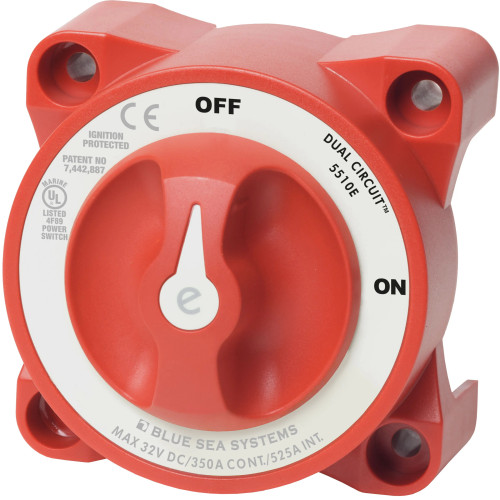
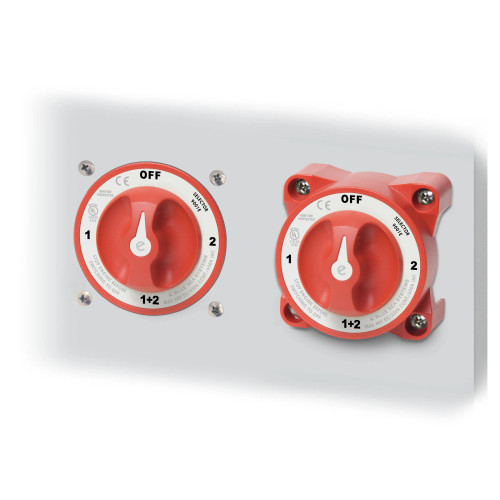
Blue Sea Systems e-Series Battery Switch, IP66, Ignition Protected, 3/8 in Studs











-
Perfect Fit, Guaranteed
Get the right part every time
-
Expert Support
Our in-house specialists know our products inside and out
-
Enhanced Value & Service
We go beyond the sale with professional and balanced services
-
Wordwide Delivery
Enjoy hassle-free worldwide delivery
Blue Sea Systems e-Series Battery Switch, IP66, Ignition Protected, 3/8 in Studs

Blue Sea Systems e-Series Battery Switch, IP66, Ignition Protected, 3/8 in Studs
Overview
The Blue Sea Systems e-Series is a range of manual battery switches for controlling battery banks and main DC loads on boats. These switches are built for high-current battery circuits, with configurations for single-battery isolation, selector switching between battery banks, dual-circuit switching, and battery combine functions for emergency starting or shared loads.
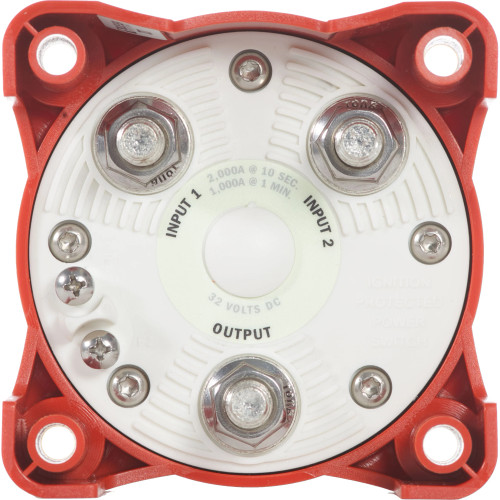
Across the range, e-Series switches use tinned copper 3/8"-16 (M10) terminal studs, accept up to 4/0 AWG battery cable, and use mounting holes for 1/4" (M6) screws. Depending on the configuration, ratings include up to 350A continuous service, 600A intermittent service for selector and single-circuit models, and 700A starting service per circuit on dual-circuit versions. The housings are IP66 rated and ignition protected, making them suitable for installation on gasoline powered boats when installed correctly.
Key features
- Manual battery control for isolating a battery bank, selecting between banks, switching two circuits together, or combining banks where the selected model supports it.
- IP66 protection helps the switch handle spray and washdown exposure in exposed or semi-exposed marine locations.
- Ignition protected construction supports use aboard gasoline powered boats when the installation follows marine electrical practice.
- Tinned copper 3/8"-16 (M10) studs help maintain conductivity in the damp, salt-air environment around battery compartments.
- Accepts up to 4/0 AWG cable, giving installers room for large battery conductors used on starting and house-bank circuits.
- Case design supports surface or rear panel mounting, which helps with refits where the battery switch must match an existing panel or bulkhead layout.
- Selector and Dual Circuit Plus configurations use make-before-break contact action, allowing switching between operating positions without a momentary power drop.
- Available with or without Alternator Field Disconnect, depending on the configuration, for systems where alternator protection is required.
Variants
This e-Series range includes seven configurations. The available differences are switch type, switch position count, battery combine capability, and whether Alternator Field Disconnect is included. Single-circuit ON-OFF models are for one battery feeding one load group, selector models are for choosing between battery banks, and dual-circuit models are for switching two isolated circuits at the same time.
Battery combine versions add a combine position for connecting banks when the system layout calls for it. AFD versions include Alternator Field Disconnect, which is used in compatible alternator field wiring to help protect alternator diodes if the switch is turned off while the engine is running. The correct variant should match the boat wiring diagram, number of battery banks, alternator setup, and whether a combine function is part of the intended battery management layout.
Installation and setup
Installation should be planned around cable size, stud access, and the path of the main battery conductors. The terminal studs are specified for 140 in-lb of torque, and the body provides 1.10 in of cable clearance for 4/0 AWG conductors. That matters in real battery compartments, where stiff cable, lug stacking, and service access can affect how cleanly the switch can be mounted and inspected.
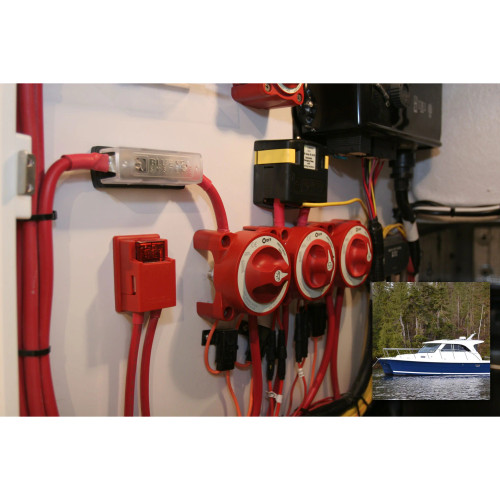
The switch is a good match for helm-adjacent electrical panels, battery lockers, engine room bulkheads, and refit panels where a clear manual disconnect is needed. Keep the switch close enough to the battery system for practical cable routing, but positioned where the knob can be reached quickly and the cable terminations remain protected from accidental contact.
Compatibility and fit
These switches are intended for DC battery switching on marine electrical systems, including starting and house-bank arrangements on powerboats and sailboats. Selector and combine configurations are commonly used where the operator needs manual control over which battery bank feeds the load side. Dual-circuit versions fit layouts where two isolated battery circuits need to be switched together from one knob.
For gasoline powered boats, the ignition protected rating is important for installations near machinery spaces or battery areas where fuel vapor risk must be considered. For any installation that involves alternator field wiring, battery combine, or switching both positive and negative conductors, the exact switch configuration and wiring diagram should be matched before installation.
Marine environment and service care
The red switch body gives clear visibility in a battery compartment or DC control area, while the tactile knob position helps the operator confirm the switch setting by feel. The IP66 housing rating supports use in marine locations exposed to spray, but terminal protection, strain relief, and clean cable routing still matter for long service life.
Routine checks should include looking for loose lugs, heat discoloration, corrosion at the terminals, and cable movement around the switch. A marine electrical protectant can be used on exposed metal contact areas when applied correctly, but it should never be used as a substitute for proper torque, correct cable sizing, and clean terminations.
We ship all in-store (FL) stock orders the same day if placed before 3 PM EST, Monday through Friday. Orders placed after this time will ship the next business day. Orders fulfilled from other warehouses or manufacturers may not ship the same day. If an item is out of stock, we will notify you promptly.
Related Products
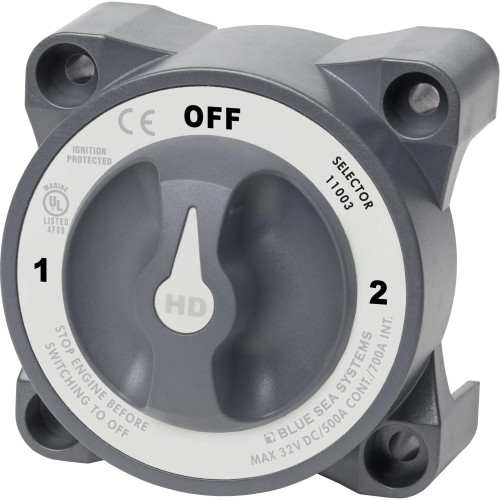

Blue Sea Systems HD-Series Heavy Duty Battery Switch, 32V DC, IP66, Ignition Protected, 4/0 AWG Cable, 1/2 in Studs


Blue Sea Systems m-Series Selector 3 Position Battery Switch, 32V DC, 300A, IP66


Blue Sea Systems m-Series Single Circuit ON-OFF Battery Switch, Locking Key, 48V DC, 300A Continuous, IP66, 3/8 in Studs


Blue Sea Systems L-Series Solenoid Switch, 12/24V, 250A, SPST-NO, Ignition Protected


Blue Sea Systems m-Series Mini Selector Battery Switch, 4 Position, Battery Combine, 300A, 32V DC, IP66