


Blue Sea Systems PowerBar 1000 Busbar, 1000A, 150V, Tin-Plated Copper, Snap-On Insulating Cover


-
Perfect Fit, Guaranteed
Get the right part every time
-
Expert Support
Our in-house specialists know our products inside and out
-
Enhanced Value & Service
We go beyond the sale with professional and balanced services
-
Wordwide Delivery
Enjoy hassle-free worldwide delivery
Blue Sea Systems PowerBar 1000 Busbar, 1000A, 150V, Tin-Plated Copper, Snap-On Insulating Cover

Blue Sea Systems PowerBar 1000 Busbar, 1000A, 150V, Tin-Plated Copper, Snap-On Insulating Cover
Overview
The Blue Sea Systems PowerBar 1000 is a high-capacity busbar for bringing large and small conductors together in a single, organized connection point on a boat. It carries a 1,000A continuous rating and supports systems up to 150V, making it a strong match for larger DC distribution layouts, inverter feeds, battery banks, fuse block connections, and other high-current marine circuits.
The bus is made from tin-plated C11000 copper, with a stepped layout that places conductors on two elevations to help keep heavy cable runs and smaller branch connections easier to route. Each configuration includes terminal studs for main conductors, #10-32 and #8-32 terminal screws for smaller gauge wires, and a snap-on insulating cover with a label recess.
The base is made from UL 94-V0 rated glass-reinforced thermoplastic, and the cover helps the finished installation meet ABYC and USCG requirements for insulated high-current connections. The bar can also be shortened where space is tight, which is useful in battery compartments, electrical panels, and machinery spaces where cable bend radius and service access both matter.
Key features
- 1,000A continuous rating for large marine DC distribution systems.
- 150V maximum voltage rating for compatibility with common low-voltage marine electrical architectures.
- Tin-plated C11000 copper bus material for conductivity and resistance to corrosion in marine electrical spaces.
- Stepped bus layout gives conductors two working elevations, helping reduce crowding when several large cables land in the same area.
- Accepts both terminal studs and terminal screws, so large conductors and smaller accessory or fuse block connections can share the same distribution point.
- One-piece serrated flange nuts help maintain secure stud connections after proper torque is applied.
- Stainless steel 8-32 screws with captive lock washers support smaller gauge wire terminations.
- Mounting holes accept #10 or M5 screws for installation on panels, boards, or other suitable mounting surfaces.
- Snap-on insulating cover includes a label recess and supports ABYC and USCG compliant installation practices.
- Bi-directional end caps allow additional busbars to be ganged when the electrical system needs more distribution capacity.
Variants
The PowerBar 1000 is offered in four configurations. The options change by terminal stud size and the number of terminal studs, while the core 1,000A busbar layout, 150V maximum voltage rating, tin-plated copper bus material, and insulated cover remain consistent across the range.
The 3/8-inch stud versions use 3/8-inch-16 terminal studs with a 140 in-lb terminal stud torque. The 5/16-inch stud versions use 5/16-inch-18 terminal studs with a 120 in-lb terminal stud torque.
- 1990 has 3/8-inch terminal studs and 8 studs. This layout suits installations with fewer main cable landings while keeping the larger 3/8-inch stud size for heavy conductors.
- 1992 has 5/16-inch terminal studs and 8 studs. This version keeps the shorter 8-stud format while matching systems already built around 5/16-inch ring terminals.
- 1991 has 3/8-inch terminal studs and 12 studs. The added stud count gives more main connection points for larger DC distribution layouts that use 3/8-inch lugs.
- 1993 has 5/16-inch terminal studs and 12 studs. This configuration gives the higher stud count while keeping 5/16-inch terminal compatibility for matching cable hardware.
Installation and setup
Mount the PowerBar 1000 on a dry, serviceable electrical surface where the cover can be removed for inspection and where connected cables are properly supported. The bar accepts #10 or M5 mounting screws, and the installation should leave enough room for ring terminals, bend radius, labels, and tool access for torque checks.
The busbar may be cut to a shorter length when the available mounting space is limited. After any modification, the finished installation still needs clean conductor routing, protected positive conductors where applicable, and a cover fitted over exposed high-current terminals.
Electrical integration
This busbar is useful where several high-current circuits need a common distribution point, such as battery banks, inverter circuits, charging systems, DC panels, or fuse block groups. The matching elevations between the busbar and common fuse blocks can reduce the need for extra connecting cables, which helps keep the installation cleaner and easier to inspect.
Ring terminal size should match the selected stud version, and all connections should be tightened to the correct torque for that stud size. The smaller screw terminals are intended for smaller conductor connections and use the listed #10-32 and #8-32 screw hardware rather than the main terminal studs.
We ship all in-store (FL) stock orders the same day if placed before 3 PM EST, Monday through Friday. Orders placed after this time will ship the next business day. Orders fulfilled from other warehouses or manufacturers may not ship the same day. If an item is out of stock, we will notify you promptly.
Related Products

Blue Sea Systems PowerBar Dual BusBar, 200A, 48V DC, 3/8"-16 Studs, Tin-Plated Copper, With Insulators

Blue Sea Systems PowerBar BusBar Cover, For 2104, Polycarbonate

Blue Sea Systems PowerBar Dual BusBar, 200A, 48V DC, Two 3/8"-16 Studs, Tin-Plated Copper
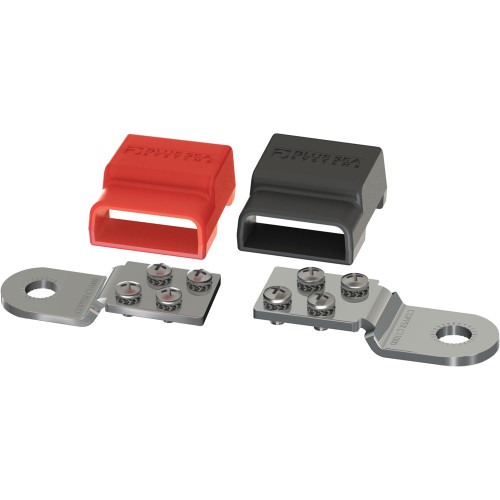

Blue Sea Systems Battery Terminal Mount BusBars, 100A, 32V, Tin-Plated Copper


Blue Sea Systems MaxiBus 250A BusBar, 300V AC, 48V DC, Tin-Plated Copper